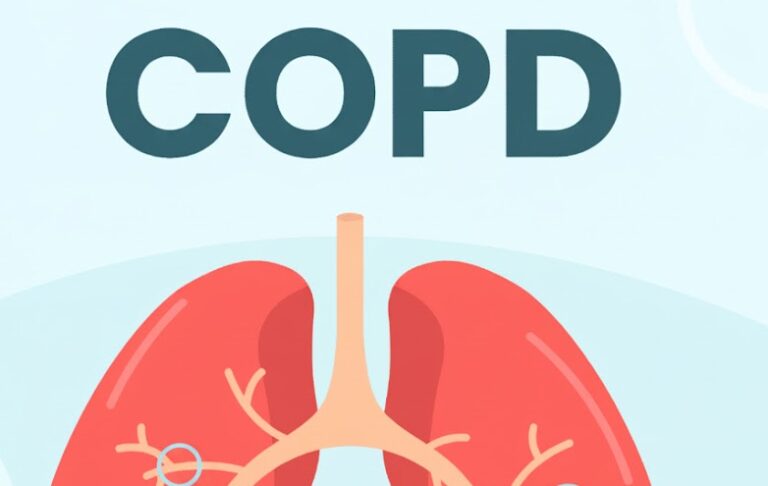
COPD ek long-term lung disease hai jisme patient ko saans lene me dikkat (breathing difficulty) hoti hai.
Ye disease slowly-slowly badhti hai aur usually smoking, pollution, ya chronic lung infection ke karan hoti hai.
📘 Definition
COPD (Chronic Obstructive Pulmonary Disease) is defined as:
“A chronic and progressive disease of the lungs characterized by airflow obstruction that is not fully reversible.”
Simple words me:
COPD ek aisi lung problem hai jisme hawa (air) lungs ke andar aur bahar freely move nahi kar pati.
🫁 Types of COPD
| Type | Description |
|---|---|
| Chronic Bronchitis | Long-term inflammation of airways (bronchi) causing cough and mucus production. |
| Emphysema | Damage to alveoli (air sacs) in lungs causing poor oxygen exchange. |
⚠️ Causes / Risk Factors
| Causes | Description |
|---|---|
| Smoking | Most common cause; damages lung tissue. |
| Air Pollution | Exposure to dust, smoke, and harmful gases. |
| Occupational Exposure | Working in mines, factories, or chemical industries. |
| Genetic Factors | Deficiency of alpha-1 antitrypsin enzyme. |
| Respiratory Infections | Repeated lung infections since childhood. |
🧠 Pathophysiology (Simple Explanation)
1️⃣ Chronic irritation (from smoke or pollution) causes inflammation in airways.
2️⃣ Airways become narrow and swollen.
3️⃣ Mucus (sputum) increases → blocks airflow.
4️⃣ Alveoli (air sacs) lose elasticity → less oxygen exchange.
5️⃣ Patient experiences shortness of breath (dyspnea).
💨 Signs and Symptoms
- Shortness of breath (especially on exertion)
- Chronic cough with sputum
- Wheezing sound while breathing
- Chest tightness
- Fatigue and weakness
- Cyanosis (bluish discoloration of lips/fingers)
- Weight loss (in severe cases)
- Barrel-shaped chest (in emphysema)
🧬 Diagnosis
| Test Name | Purpose |
|---|---|
| History & Physical Exam | Long-term cough, smoking history, and wheezing. |
| Spirometry (PFT) | Measures airflow obstruction (low FEV1/FVC ratio). |
| Chest X-ray | Shows hyperinflated lungs. |
| CT Scan | Detects emphysema and airway changes. |
| ABG (Arterial Blood Gas) | Measures oxygen and carbon dioxide levels. |
| Pulse Oximetry | Measures oxygen saturation. |
🏥 Treatment and Management
1️⃣ Medical Management
- Bronchodilators – relax airway muscles (Salbutamol, Ipratropium).
- Corticosteroids – reduce inflammation (Budesonide, Prednisolone).
- Antibiotics – for infection.
- Oxygen Therapy – if oxygen level is low.
- Mucolytics – to loosen mucus.
- Vaccination – Influenza & Pneumococcal to prevent infection.
2️⃣ Lifestyle & Supportive Management
- Stop smoking immediately 🚭
- Avoid polluted air and allergens
- Encourage deep breathing exercises
- Maintain healthy diet (high protein, small frequent meals)
- Adequate rest and hydration
- Pulmonary rehabilitation programs
🩺 Nursing Management
| Nursing Aspect | Nursing Action |
|---|---|
| Assessment | Monitor respiratory rate, pattern, and effort. |
| Position | Fowler’s or orthopneic position to ease breathing. |
| Oxygen | Administer low-flow oxygen (1–2 L/min). |
| Breathing Exercises | Encourage pursed-lip and diaphragmatic breathing. |
| Medication | Give bronchodilators and steroids as prescribed. |
| Hydration | Encourage fluids to loosen sputum. |
| Rest | Provide adequate rest between activities. |
| Education | Teach smoking cessation and home care measures. |
🧘♀️ Prevention
- Avoid smoking and second-hand smoke.
- Wear mask in dusty or polluted environment.
- Get flu and pneumonia vaccines.
- Maintain good nutrition and hydration.
- Regular follow-up with healthcare provider.